 Known to be toxic - All parts of red trillium are considered poisonous if eaten, particularly the roots and berries. Ingestion can cause gastrointestinal upset and other symptoms.
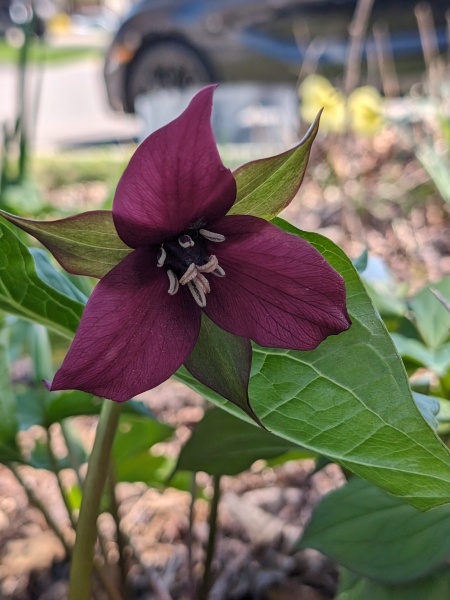
Source: Donna Bos
Plant Names

Trillium erectum
Red Trillium
Trille rouge
Synonyms
birthwort
ill-scented trillium
ill-scented wakerobin
purple trillium
wakerobin
trille dressé
Plant Characteristics
Bloom Colour: Red
Bloom Period: Apr - May
Max Height: 2.0 feet
Max Width: 1.0 feet (spreads by rhizome)
Light Condition:
 Less than 2 or 3 hours of direct sun a day
Soil conditions:
Less than 2 or 3 hours of direct sun a day
Soil conditions:
 Tolerates medium soil condition
Less than 2 or 3 hours of direct sun a day
Tolerates medium soil condition
Lifespan:
Perennial
plants that will come back year after year
(Spring Ephemeral)
Gardener Experience:
 Does not spread uncontrollably
 Spreads by rhizome
Does not spread uncontrollably
Spreads by rhizome
Landscape Uses:
 Suitable for woodland gardens
Suitable for woodland gardens
Ecological Benefits:
No ecological benefits information available.
Tolerates:
 Deer resistant
 Rabbit resistant
 Tolerates limestone conditions
 Tolerates juglone conditions
 Tolerates transplantation
Deer resistant
Rabbit resistant
Tolerates limestone conditions
Tolerates juglone conditions
Tolerates transplantation
Special Features and Considerations:
 This plant causes skin rashes
This plant causes skin rashes
Seed and plant distribution status
No seeds available for this plant.
We currently accept seeds for this plant
Fun Facts
Red Trillium has three broad, mottled green leaves and a single, nodding flower. The flowers are usually deep red to maroon, although colour can vary from reddish-purple to pink. They appear in spring, often before the woodland canopy is fully developed. The flowers are sometimes described as having a distinctive, slightly unpleasant scent that attracts their natural pollinators. After flowering, a single berry develops and eventually matures. It is an excellent choice for a native woodland or shade garden.
Red Trillium is very slow growing and slow to establish, particularly from seed. Once established, it can form attractive colonies over many years. Keep the soil consistently moist, particularly during establishment. A thick layer of leaf mulch helps recreate its natural woodland conditions. Avoid disturbing or transplanting established plants whenever possible. The foliage naturally disappears after flowering as the plant goes dormant for the summer—this is normal and not a sign that the plant has died. Do not cut the foliage while it is still green; the plant needs the leaves to replenish its underground energy reserves. Avoid heavily fertilized or frequently disturbed garden beds.
Red Trillium is very slow growing and slow to establish, particularly from seed. Once established, it can form attractive colonies over many years. Keep the soil consistently moist, particularly during establishment. A thick layer of leaf mulch helps recreate its natural woodland conditions. Avoid disturbing or transplanting established plants whenever possible. The foliage naturally disappears after flowering as the plant goes dormant for the summer—this is normal and not a sign that the plant has died. Do not cut the foliage while it is still green; the plant needs the leaves to replenish its underground energy reserves. Avoid heavily fertilized or frequently disturbed garden beds.
Plant Location
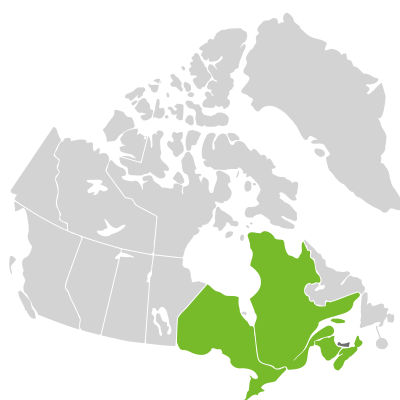
Native to Ottawa region: Yes
Distribution according to VASCAN
Ephemeral
Native
Introduced
Excluded
Extirpated
Doubtful
Absent
 Canadensis

Thrives in Ecozones
- Atlantic Maritime
- Boreal Shield
- Mixed Wood Plains
Ecological Benefits
Butterflies Supported by Trillium erectum
-
Crambodes talidiformis
Verbena -
Euplexia benesimilis
American Angle Shades
Specialized Bees Supported by Trillium erectum
No bee data available for this plant.
Complementary Plants
- Anemone parviflora
Small-flowered Anemone
Anémone à petites fleurs - Erythronium albidum
White Trout Lily
Érythrone blanchâtre - Gaultheria procumbens
Eastern Teaberry
Thé des bois - Trillium grandiflorum
White Trillium
Trille blanc - Viola sororia
Woolly Blue Violet
Violette parente
Substitute For Non-Native Plants
- Plantago (Non-Native Plantain)
- Lamium (Dead nettle)
- Ajuga reptans (Bugleweed)
- Lysimachia nummularia (Creeping Jenny)
- Iridaceae (Crocus)
- Scilla siberica (Siberian Squill)
- Salvia (Non-Native Sage)
- Hyacinthus (Non-Native Hyacynth)
- Petunia (Non-Native Petunias)
- Myosotis sylvatica (Forget-me-not)
- Phlox subulata (Moss Phlox)
Sowing Information
Download Seed Envelope Labels (PDF)
- Sowing depth: Sow just below surface
- Sow anytime
- Stratification duration: 0 days
- Notes: Double dormancy.
Harvesting and Seed Sharing
- Harvest start month: July
- Harvesting indicator:
- Berries are ripen and easily fall off or have fallen off
- Harvesting:
- Squeeze berries to extract seeds, wash with soapy water, rinse throroughly
- Seed viability test:
- No test needed before donating
- Packaging measure: Six (6) seeds (eyeball)
- Seed storage:
- Keep moist and cool, in a ziploc bag, in the fridge, with the seeds in soil, paper towel or coffee filter, until donation
- Cultivar: Yes, do not donate unless you know source, and there are no known cultivars in your garden or at proximity
- No harvesting video available at this time.
Toxicity Notes
All parts of red trillium are considered poisonous if eaten, particularly the roots and berries. Ingestion can cause gastrointestinal upset and other symptoms.