Source: OWSL
Plant Names

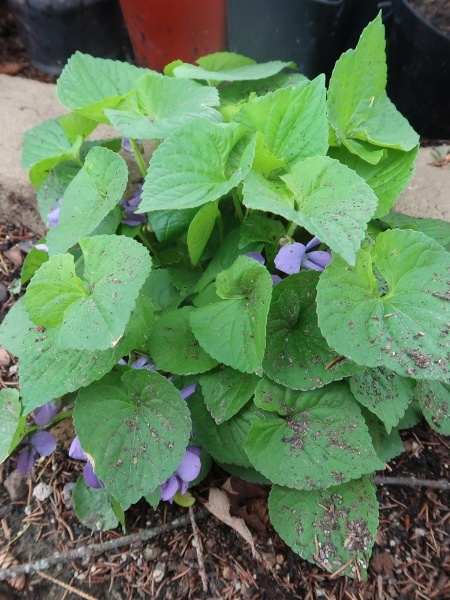
Viola sororia
Woolly Blue Violet
Violette parente
Synonyms
blue prairie violet
dooryard violet
downy blue violet
hooded blue violet
violette commune
Plant Characteristics
Bloom Colour: Purple
Bloom Period: Apr - Nov
Max Height: 0.5 feet
Max Width: 0.7 feet (spreads by rhizome)
Light Condition:
 More than 6 hours of direct sun a day
 More than 2 or 3 hours but less than 6 hours of direct sun a day
 Less than 2 or 3 hours of direct sun a day
Soil conditions:
Less than 2 or 3 hours of direct sun a day
Soil conditions:
 Tolerates medium soil condition
More than 6 hours of direct sun a day
More than 2 or 3 hours but less than 6 hours of direct sun a day
Less than 2 or 3 hours of direct sun a day
Tolerates medium soil condition
Lifespan:
Perennial
plants that will come back year after year
Gardener Experience:
 Spreads by rhizome
 Easy to germinate
 Self-seeding
Spreads by rhizome
Easy to germinate
Self-seeding
Landscape Uses:
 Suitable for Right of Way gardens
 Suitable for container garden
 Suitable for ground cover
 Suitable for woodland gardens
 Tolerates boulevard garden conditions
Suitable for Right of Way gardens
Suitable for container garden
Suitable for ground cover
Suitable for woodland gardens
Tolerates boulevard garden conditions
Ecological Benefits:
 Supports pollinators
 Butterfly host
 Bee host
Supports pollinators
Butterfly host
Bee host
Tolerates:
 Tolerates foot traffic around the plant
 Tolerates limestone conditions
 Tolerates sandy conditions
 Tolerates juglone conditions
 Tolerates transplantation
Tolerates foot traffic around the plant
Tolerates limestone conditions
Tolerates sandy conditions
Tolerates juglone conditions
Tolerates transplantation
Special Features and Considerations:
 This plant causes skin rashes
This plant causes skin rashes
Seed and plant distribution status
No seeds available for this plant.
We currently accept seeds for this plant
Fun Facts
Woolly Blue Violet has blue-purple spring flowers and softly hairy leaves and stems. Like many violets, it can quietly establish itself in a garden and eventually create a lovely spring carpet. The flowers aren't all the same. In addition to its showy spring flowers, violets can produce small, closed flowers called cleistogamous flowers later in the season.
Violets are famous for their unusual seed-dispersal strategy: when the seed capsules mature, they can eject their seeds several feet away, helping the plant spread. The name “woolly” refers to the plant's hairy or softly pubescent stems and leaves, which distinguish it from some smoother-leaved violets.
Whoolly Blue Violet can be surprisingly persistent once established. A plant that looks like a small, innocent woodland perennial can eventually pop up throughout a lawn or garden. Decide whether you want a groundcover or a specimen plant. Woolly Blue Violet is lovely when allowed to form a colony, but it is not a plant for gardeners who want every perennial to remain exactly where it was planted.
Violets are famous for their unusual seed-dispersal strategy: when the seed capsules mature, they can eject their seeds several feet away, helping the plant spread. The name “woolly” refers to the plant's hairy or softly pubescent stems and leaves, which distinguish it from some smoother-leaved violets.
Whoolly Blue Violet can be surprisingly persistent once established. A plant that looks like a small, innocent woodland perennial can eventually pop up throughout a lawn or garden. Decide whether you want a groundcover or a specimen plant. Woolly Blue Violet is lovely when allowed to form a colony, but it is not a plant for gardeners who want every perennial to remain exactly where it was planted.
Plant Location
Native to Ottawa region: Yes
Distribution according to VASCAN
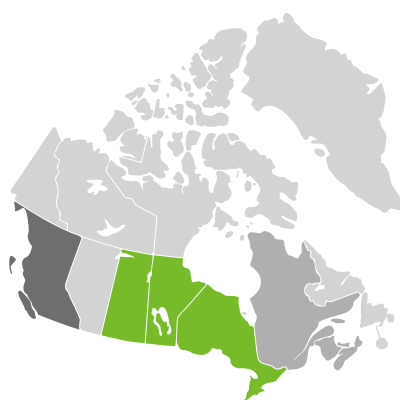
Ephemeral
Native
Introduced
Excluded
Extirpated
Doubtful
Absent
 Canadensis

Thrives in Ecozones
- Boreal Plains
- Mixed Wood Plains
Ecological Benefits
Butterflies Supported by Viola sororia
-
Argynnis cybele
Great Spangled Fritillary - Argynne Cybèle -
Boloria bellona
Meadow fritillary - Boloria des Prés -
Euptoieta claudia
Variegated Fritillary - Fritillaire Panachée -
Speyeria aphrodite
Aphrodite fritillary - Argynne Aphrodite -
Trichordestra legitima
Striped Garden Caterpillar -
Xestia smithii
Smith's Dart
Specialized Bees Supported by Viola sororia
- Andrena integra
- Andrena platyparia
- Andrena violae
Complementary Plants
- Anemone parviflora
Small-flowered Anemone
Anémone à petites fleurs - Erythronium albidum
White Trout Lily
Érythrone blanchâtre - Gaultheria procumbens
Eastern Teaberry
Thé des bois - Trillium erectum
Red Trillium
Trille rouge - Trillium grandiflorum
White Trillium
Trille blanc
Substitute For Non-Native Plants
- Plantago (Non-Native Plantain)
- Lamium (Dead nettle)
- Ajuga reptans (Bugleweed)
- Lysimachia nummularia (Creeping Jenny)
- Iridaceae (Crocus)
- Scilla siberica (Siberian Squill)
- Salvia (Non-Native Sage)
- Hyacinthus (Non-Native Hyacynth)
- Petunia (Non-Native Petunias)
- Myosotis sylvatica (Forget-me-not)
- Phlox subulata (Moss Phlox)
Sowing Information
Download Seed Envelope Labels (PDF)
- Sowing depth: Surface sow
- Sow by February
- Stratification duration: 60 days
- Self-seeding
- Notes: Best planted outdoors in fall.
Harvesting and Seed Sharing
- Harvest start month: June
- Harvesting indicator:
- Pods are brown and slightly open
- Harvesting:
- Open the pod, remove seeds
- Seed viability test:
- No test needed before donating
- Packaging measure: 1 rounded 1/8 teaspoon
- Seed storage:
- Air dry in paper bag or open container, for a few days until crisp
- Shake seeds to move them once in a while to prevent molding
- Cultivar: Yes, do not donate unless you know source, and there are no known cultivars in your garden or at proximity
- Remove non-seed material
- Harvesting video: Watch here
Toxicity Notes
Inadequate information on toxicity found.