 Pas connu comme étant toxique - Not likely toxic to mammals.
Notice: We do not accept seeds that were given before 2025 as they were in fact Spotted Joe-Pye-weed (Eutrochium maculatum).
Plant Names

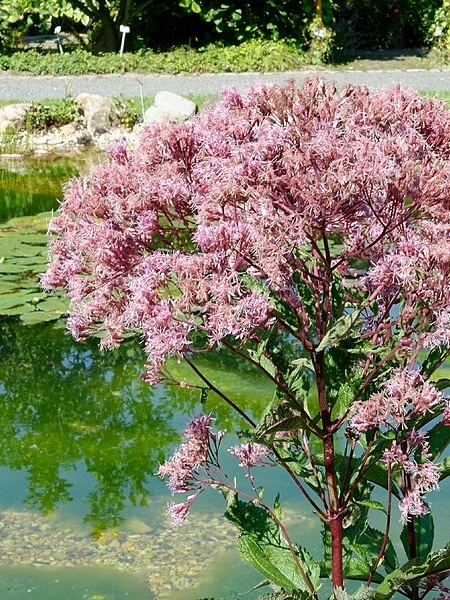
Eutrochium purpureum
Purple Joe Pye Weed
Eupatoire pourpre
Synonyms
green-stemmed Joe-Pye-weed
purple-jointed Joe-Pye-weed
purple-node Joe-Pye-weed
sweet Joe-Pye-weed
sweet-scented Joe-Pye-weed
eupatoire d'eau rouge
Plant Characteristics
Couleur de floraison: Rose
Bloom Period: Jul - Sep
Hauteur max: 7,0 feet
Max Width: 4,0 feet (spreads by rhizome)
Light Condition:
 Less than 2 or 3 hours of direct sun a day
Soil conditions:
Less than 2 or 3 hours of direct sun a day
Soil conditions:
 Tolerates medium soil condition
Less than 2 or 3 hours of direct sun a day
Tolerates medium soil condition
Lifespan:
Vivace
des plantes qui reviennent année après année
Gardener Experience:
 Suitable for beginner gardeners
 Ne se propage pas de manière incontrôlable
 Spreads by rhizome
 Self-seeding
Suitable for beginner gardeners
Ne se propage pas de manière incontrôlable
Spreads by rhizome
Self-seeding
Landscape Uses:
 Suitable for rain gardens
 Suitable for shoreline rehabilitation
 Suitable for school gardens
 Suitable for woodland gardens
Suitable for rain gardens
Suitable for shoreline rehabilitation
Suitable for school gardens
Suitable for woodland gardens
Ecological Benefits:
 Supports hummingbirds
 Butterfly host
Supports hummingbirds
Butterfly host
Tolerates:
 Deer resistant
 Rabbit resistant
 Tolerates limestone conditions
 Tolerates sandy conditions
 Tolerates juglone conditions
Deer resistant
Rabbit resistant
Tolerates limestone conditions
Tolerates sandy conditions
Tolerates juglone conditions
Special Features and Considerations:
Seed and plant distribution status
Semences disponible
Disponible à la table Ombre
Disponible à la table Ombre
Nous acceptions les semences de cette plante
Faits intéressants
Purple Joe Pye Weed has large domed clusters of soft pink flowers from mid- to late summer. It prefers moist, fertile soil and is ideal for meadow plantings, and woodland edges. It forms tidy clumps and spreads slowly. It prefers consistent moisture.
Plant Location
Distribution according to VASCAN
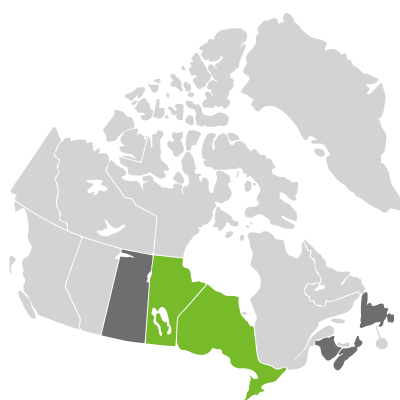
Ephemeral
Native
Introduced
Excluded
Extirpated
Doubtful
Absent
 Canadensis

Thrives in Ecozones
- Plaines boréales
- Plaines à forêts mixtes
Ecological Benefits
Butterflies Supported by Eutrochium purpureum
-
Schinia trifascia
Three lined flower
Specialized Bees Supported by Eutrochium purpureum
No bee data available for this plant.
Complementary Plants
- Bromus pubescens
Hairy Woodland Brome
Brome pubescent - Nabalus altissimus
Tall Rattlesnakeroot
Prenanthe élevée - Scrophularia lanceolata
Lance-leaved Figwort
Scrofulaire lancéolée - Verbena urticifolia
White Vervain
Verveine à feuilles d'ortie - Verbesina alternifolia
Wingstem
Verbésine à feuilles alternes
Substitute For Non-Native Plants
- Sorbaria sorbifolia (False spirea)
- Aruncus dioicus (Goat's Beard)
- Polygonatum odoratum (Solomon's Seal)
- Aegopodium podagraria (Goutweed)
- Thalictrum (Non-Native Meadow Rue)
- Symphiotrichum (Non-Native Aster)
Sowing Information
Download Seed Envelope Labels (PDF)
- Sowing depth: Couvrir très légèrement
- Sow by March
- Stratification duration: 30 days
- Self-seeding
Harvesting and Seed Sharing
- Harvest start month: August
- Harvesting indicator:
- Seeds have become fluffy and can be easily removed by shaking on gently pulling off from stem
- Harvesting:
- Secouer le porte-graines dans un sac de papier
- Seed viability test:
- Pas de test requis avant le don
- Packaging measure: 1 rounded 1/4 teaspoon
- Seed storage:
- Sécher à l'air dans un sac en papier ou contenant ouvert, pour quelques jours jusqu'à sec
- Secouer de temps à autre pour prévenir la moisissure
- Cultivar: Yes, do not donate unless you know source, and there are no known cultivars in your garden or at proximity
- Harvesting notes: Please note that in 2025, we partly distributed Spotted Joe-Pye Weed (Eutrochium maculatum) instead of Purple Joe-Pye Weed (Eutrochium purpureum). Please double-check your plants before donating. Thanks!
- Harvesting video: Watch here
Toxicity Notes
Not likely toxic to mammals.