 Pas connu comme étant toxique - Not known to be toxic to mammals if ingested.
Plant Names

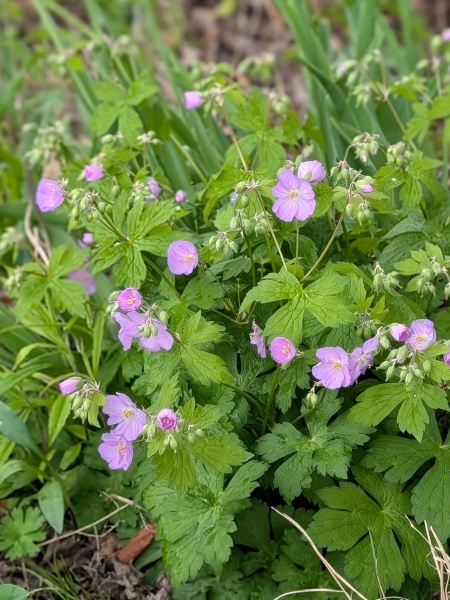
Geranium maculatum
Spotted Geranium
Géranium maculé
Synonyms
spotted crane's-bill
Plant Characteristics
Couleur de floraison: Violet
Bloom Period: May - Jul
Hauteur max: 1,0 feet
Max Width: 1,0 feet (spreads by rhizome)
Light Condition:
 Plus de 6 heures d'ensoleillement par jour
 More than 2 or 3 hours but less than 6 hours of direct sun a day
 Less than 2 or 3 hours of direct sun a day
Soil conditions:
Less than 2 or 3 hours of direct sun a day
Soil conditions:
 Tolerates medium soil condition
Plus de 6 heures d'ensoleillement par jour
More than 2 or 3 hours but less than 6 hours of direct sun a day
Less than 2 or 3 hours of direct sun a day
Tolerates medium soil condition
Lifespan:
Vivace
des plantes qui reviennent année après année
Gardener Experience:
 Suitable for beginner gardeners
 Ne se propage pas de manière incontrôlable
 Spreads by rhizome
 Self-seeding
Suitable for beginner gardeners
Ne se propage pas de manière incontrôlable
Spreads by rhizome
Self-seeding
Landscape Uses:
 Suitable for Right of Way gardens
 Suitable for rain gardens
 Suitable for container garden
 Suitable for woodland gardens
 Tolerates boulevard garden conditions
Suitable for Right of Way gardens
Suitable for rain gardens
Suitable for container garden
Suitable for woodland gardens
Tolerates boulevard garden conditions
Ecological Benefits:
 Butterfly host
 Bee host
Butterfly host
Bee host
Tolerates:
 Tolerates salt conditions
 Deer resistant
 Rabbit resistant
 Tolerates limestone conditions
 Tolerates sandy conditions
 Tolerates juglone conditions
Tolerates salt conditions
Deer resistant
Rabbit resistant
Tolerates limestone conditions
Tolerates sandy conditions
Tolerates juglone conditions
Special Features and Considerations:
 This plant is septic tank safe
This plant is septic tank safe
Seed and plant distribution status
No seeds available for this plant.
Nous acceptions les semences de cette plante
Faits intéressants
Spotted Geranium is a clump forming plant that has some of the showiest flowers in the geranium family. It grows well in open woodland gardens, shady borders and native gardens. It can also be grown as a ground cover. In the fall, their leaves can turn red and their uniquely curled stamens can provide visual interest after their blooming period is over.
Plant Location
Distribution according to VASCAN
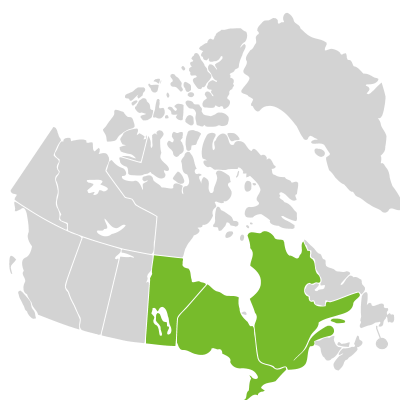
Ephemeral
Native
Introduced
Excluded
Extirpated
Doubtful
Absent
 Canadensis

Thrives in Ecozones
- Plaines boréales
- Plaines à forêts mixtes
Ecological Benefits
Butterflies Supported by Geranium maculatum
-
Amphipyra tragopoginis
Mouse moth - Triponctuée -
Prochoerodes lineola
Large Maple Spanworm
Specialized Bees Supported by Geranium maculatum
- Andrena distans
Complementary Plants
- Aquilegia canadensis
Red Columbine
Ancolie du Canada - Cryptotaenia canadensis
Canada Honewort
Cryptoténie du Canada - Elymus hystrix
Bottlebrush Grass
Élyme étalé - Osmorhiza longistylis
Smooth Sweet Cicely
Osmorhize à long style - Phlox divaricata
Wild Blue Phlox
Phlox divariqué - Sanguinaria canadensis
Bloodroot
Sanguinaire du Canada - Thalictrum pubescens
Tall Meadow-rue
Pigamon pubescent - Trillium erectum
Red Trillium
Trille rouge - Trillium grandiflorum
White Trillium
Trille blanc
Substitute For Non-Native Plants
- Lamium (Dead nettle)
- Ajuga reptans (Bugleweed)
- Convallaria majalis (Lily of the Valley)
- Iridaceae (Crocus)
- Scilla siberica (Siberian Squill)
- Salvia (Non-Native Sage)
- Myosotis sylvatica (Forget-me-not)
- Phlox subulata (Moss Phlox)
Sowing Information
Download Seed Envelope Labels (PDF)
- Sowing depth: Couvrir très légèrement
- Sow by February
- Stratification duration: 60 days
- Self-seeding
Harvesting and Seed Sharing
- Harvest start month: June
- Harvesting indicator:
- Seeds easily spring away from plant when you touch the pod
- Harvesting:
- Put a bag around the pod to capture the seeds, then touch the pod
- Seed viability test:
- Pas de test requis avant le don
- Packaging measure: A dozen (12) seeds (eyeball)
- Seed storage:
- Sécher à l'air dans un sac en papier ou contenant ouvert, pour quelques jours jusqu'à sec
- Secouer de temps à autre pour prévenir la moisissure
- Cultivar: Yes, do not donate unless you know source, and there are no known cultivars in your garden or at proximity
- Remove non-seed material
- Harvesting video: Watch here
Toxicity Notes
Not known to be toxic to mammals if ingested.