 Connu comme étant toxique - All parts of the plant, especially the berries and roots, contain toxins and should not be eaten by humans or pets.
Plant Names

Actaea rubra
Red Baneberry
Actée rouge
Plant Characteristics
Couleur de floraison: Blanc
Bloom Period: Apr - May
Hauteur max: 5,0 feet
Max Width: 1,0 feet
Light Condition:
 More than 2 or 3 hours but less than 6 hours of direct sun a day
 Less than 2 or 3 hours of direct sun a day
Soil conditions:
Less than 2 or 3 hours of direct sun a day
Soil conditions:
 Tolerates medium soil condition
 Tolère des conditions de sol humide
More than 2 or 3 hours but less than 6 hours of direct sun a day
Less than 2 or 3 hours of direct sun a day
Tolerates medium soil condition
Tolère des conditions de sol humide
Lifespan:
Vivace
des plantes qui reviennent année après année
Gardener Experience:
 Ne se propage pas de manière incontrôlable
Ne se propage pas de manière incontrôlable
Landscape Uses:
 Suitable for woodland gardens
Suitable for woodland gardens
Ecological Benefits:
No ecological benefits information available.
Special Features and Considerations:
Seed and plant distribution status
Semences disponible
Disponible à la table Ombre
Disponible à la table Ombre
Nous acceptions les semences de cette plante
Faits intéressants
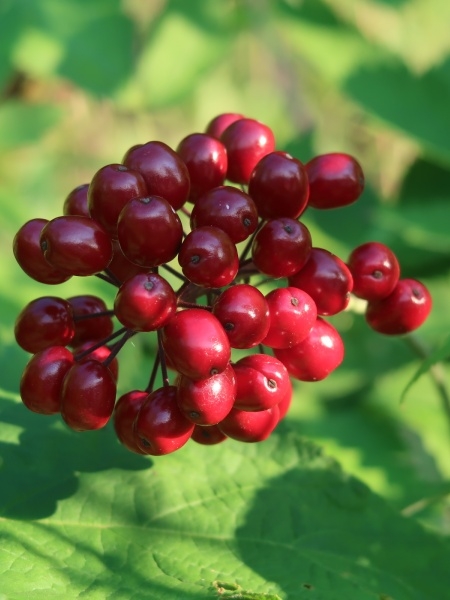
Red baneberry produces clusters of small white flowers in spring followed by bright red berries on red stalks, creating a striking display in late summer. It prefers cool, shady areas with rich organic soil. It is an excellent choice for shaded native gardens, woodland restoration, and naturalized areas. It is slow growing and long-lived. It will form tidy clumps and does not spread aggressively.
Plant Location
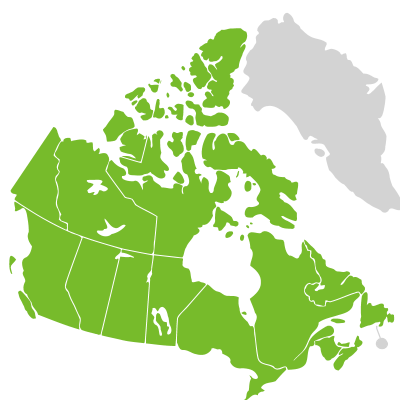
Distribution according to VASCAN
Ephemeral
Native
Introduced
Excluded
Extirpated
Doubtful
Absent
 Canadensis

No ecozone information available for this plant.
Ecological Benefits
Butterflies Supported by Actaea rubra
No butterfly data available for this plant.
Specialized Bees Supported by Actaea rubra
No bee data available for this plant.
Complementary Plants
- Clintonia borealis
Yellow Clintonia
Clintonie boréale - Hepatica acutiloba
Sharp-lobed Hepatica
Hépatique à lobes aigus - Hepatica americana
Round-lobed Hepatica
Hépatique d’Amérique - Hydrophyllum virginianum
Virginia Waterleaf
Hydrophylle de Virginie - Solidago flexicaulis
Zigzag Goldenrod
Verge d'or à tige zigzagante - Symphyotrichum cordifolium
Heart-leaved Aster
Aster à feuilles cordées - Trillium erectum
Red Trillium
Trille rouge - Trillium grandiflorum
White Trillium
Trille blanc
Substitute For Non-Native Plants
No substitute plant data available for this plant.
Sowing Information
Download Seed Envelope Labels (PDF)
- Sowing depth: Couvrir très légèrement
- Sow anytime
- Stratification duration: 2 years
- Double dormancy required
Harvesting and Seed Sharing
- Harvest start month: September
- Harvesting indicator:
- Berries are ripen and easily fall off or have fallen off
- Harvesting:
- Put berries through strainer to separate seeds, then rinse with water
- Seed viability test:
- None
- Packaging measure: 1 rounded 1/8 teaspoon
- Seed storage:
- Sécher à l'air dans un sac en papier ou contenant ouvert, pour quelques jours jusqu'à sec
- Secouer de temps à autre pour prévenir la moisissure
- Cultivar: No, you can donate without knowing the source as there are only straight species
- Remove non-seed material
- No harvesting video available at this time.
Toxicity Notes
All parts of the plant, especially the berries and roots, contain toxins and should not be eaten by humans or pets.