 Inconnu - Inadequate information on toxicity found.
Plant Names

Amorpha canescens
Leadplant
Faux-indigo blanchissant
Synonyms
leadplant
buisson à plomb
Plant Characteristics
Couleur de floraison: Violet
Bloom Period: Jul - Aug
Hauteur max: 3,0 feet
Max Width: 2,0 feet (spreads by rhizome)
Light Condition:
 Plus de 6 heures d'ensoleillement par jour
Soil conditions:
Plus de 6 heures d'ensoleillement par jour
Soil conditions:
 Tolère des conditions de sol sec
 Tolerates medium soil condition
Plus de 6 heures d'ensoleillement par jour
Tolère des conditions de sol sec
Tolerates medium soil condition
Lifespan:
Vivace
des plantes qui reviennent année après année
Gardener Experience:
 Ne se propage pas de manière incontrôlable
 Spreads by rhizome
Ne se propage pas de manière incontrôlable
Spreads by rhizome
Landscape Uses:
 Suitable for rock gardens
 Suitable for school gardens
Suitable for rock gardens
Suitable for school gardens
Ecological Benefits:
 Butterfly host
 Fixes nitrogen in the soil
Butterfly host
Fixes nitrogen in the soil
Tolerates:
 Tolerates salt conditions
 Tolerates limestone conditions
 Tolerates sandy conditions
Tolerates salt conditions
Tolerates limestone conditions
Tolerates sandy conditions
Special Features and Considerations:
Seed and plant distribution status
Semences disponible
Disponible à la table Vignes, arbustes, arbres
Disponible à la table Vignes, arbustes, arbres
Nous acceptions les semences de cette plante
Faits intéressants
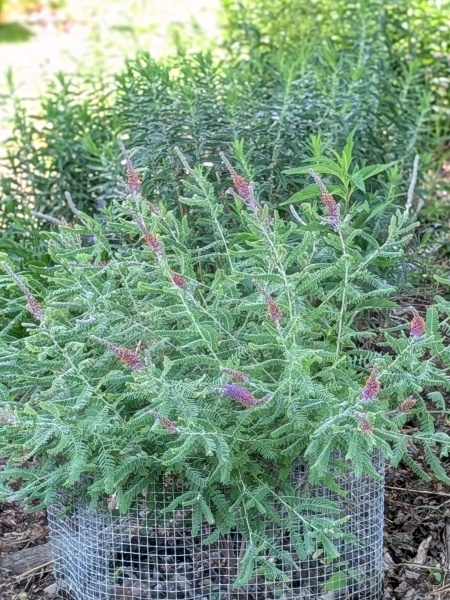
Leadplant has finely divided, silvery-gray foliage and upright spikes of small purple flowers. The flowers appear in summer and are often topped with orange or yellow anthers, creating a striking contrast with the silvery foliage. It naturally grows in dry prairies, open woodlands, and savannass. It is an excellent choice for a dry, sunny native garden or prairie planting. It is extremely drought tolerant once established. It prefers lean soil and develops a deep root system, which helps it survive drought. It is slow growing, particularly during its first few years. Avoid disturbing the roots once established. Because it is slow to leaf out in spring, don't assume it has died—give it time.
Plant Location
Distribution according to VASCAN
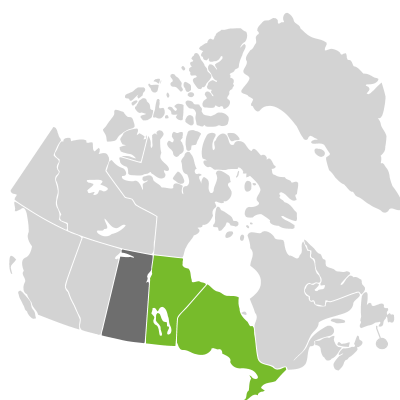
Ephemeral
Native
Introduced
Excluded
Extirpated
Doubtful
Absent
 Canadensis

Thrives in Ecozones
- Plaines boréales
- Prairies
- Plaines à forêts mixtes
Ecological Benefits
Butterflies Supported by Amorpha canescens
-
Epargyreus clarus
Silver Spotted Skipper - Hespérie à Taches Argentées -
Strymon melinus
Gray hairstreak - Porte-queue gris -
Thorybes pylades
Northern Cloudywing - Hespérie Nuageuse
Specialized Bees Supported by Amorpha canescens
No bee data available for this plant.
Complementary Plants
- Agastache scrophulariifolia
Purple Giant Hyssop
Agastache à feuilles de scrofulaire - Anemone cylindrica
Long-headed Anemone
Anémone cylindrique - Elymus canadensis
Canada Wild Rye
Élyme du Canada - Oenothera gaura
Biennial Gaura
Gaura bisannuel - Rudbeckia laciniata
Cut-leaved Coneflower
Rudbeckie laciniée
Substitute For Non-Native Plants
- Sorbaria sorbifolia (False spirea)
- Lamium (Dead nettle)
- Perovskia Atriplicifolia (Russian Sage)
- Lupinus (Non-Native Lupins)
- Ajuga reptans (Bugleweed)
- Buddleia (Butterfly Bush)
- Delphinium (Delphinium)
Sowing Information
Download Seed Envelope Labels (PDF)
- Sowing depth: Surface sow
- Sow anytime
- Stratification duration: 10 days
- Notes: Hull or scarify seeds.
Harvesting and Seed Sharing
- Harvest start month: October
- Harvesting indicator:
- Pods are slightly open and seeds inside are dark
- Harvesting:
- Utiliser la main pour détacher de la tige principale
- Seed viability test:
- Pas de test requis avant le don
- Packaging measure: 1 rounded 1/4 teaspoon
- Seed storage:
- Sécher à l'air dans un sac en papier ou contenant ouvert, pour quelques jours jusqu'à sec
- Secouer de temps à autre pour prévenir la moisissure
- Cultivar: No, you can donate without knowing the source as there are only straight species
- No harvesting video available at this time.
Toxicity Notes
Inadequate information on toxicity found.