 Pas connu comme étant toxique - Not known to be toxic to mammals if ingested.
Plant Names

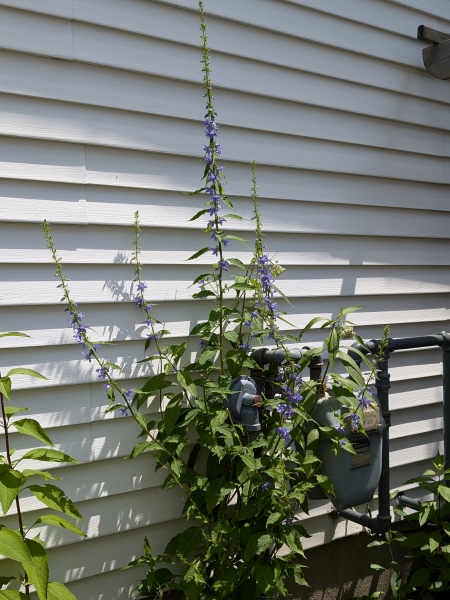
Campanulastrum americanum
American Bellflower
Campanule d'Amérique
Synonyms
tall bellflower
Plant Characteristics
Couleur de floraison: Bleu
Bloom Period: Jun - Aug
Hauteur max: 5,0 feet
Max Width: 2,0 feet
Light Condition:
 Plus de 6 heures d'ensoleillement par jour
 More than 2 or 3 hours but less than 6 hours of direct sun a day
Soil conditions:
More than 2 or 3 hours but less than 6 hours of direct sun a day
Soil conditions:
 Tolerates medium soil condition
Plus de 6 heures d'ensoleillement par jour
More than 2 or 3 hours but less than 6 hours of direct sun a day
Tolerates medium soil condition
Lifespan:
Bisannuel
des plantes qui mettront deux ans à fleurir, puis mourront
Gardener Experience:
 Suitable for beginner gardeners
 Ne se propage pas de manière incontrôlable
 Facile à germer
 Self-seeding
Suitable for beginner gardeners
Ne se propage pas de manière incontrôlable
Facile à germer
Self-seeding
Landscape Uses:
 Suitable for container garden
Suitable for container garden
Ecological Benefits:
No ecological benefits information available.
Tolerates:
 Tolerates limestone conditions
 Tolerates juglone conditions
 Tolerates transplantation
Tolerates limestone conditions
Tolerates juglone conditions
Tolerates transplantation
Special Features and Considerations:
Seed and plant distribution status
Semences disponible
Disponible à la table Plein soleil, moyen
Disponible à la table Plein soleil, moyen
Nous acceptions les semences de cette plante
Faits intéressants
American Bellflower is a tall, graceful native annual or biennial with an upright, branching form and attractive blue to violet, star-shaped flowers. The flowers appear along the upper stems from midsummer into early fall. It forms a leafy plant the first year and flowers the following year. It is best suited to informal, woodland-edge, and naturalized gardens. It can become quite tall and may benefit from support.
Plant Location
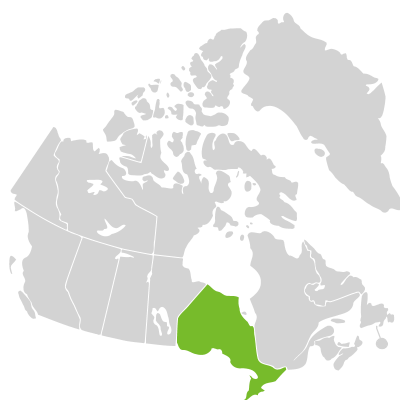
Distribution according to VASCAN
Ephemeral
Native
Introduced
Excluded
Extirpated
Doubtful
Absent
 Canadensis

Thrives in Ecozones
- Plaines à forêts mixtes
Ecological Benefits
Butterflies Supported by Campanulastrum americanum
No butterfly data available for this plant.
Specialized Bees Supported by Campanulastrum americanum
No bee data available for this plant.
Complementary Plants
- Carex crinita
Fringed Sedge
Carex crépu - Eurybia macrophylla
Large-leaved Aster
Aster à grandes feuilles - Nabalus albus
White Rattlesnake-root
Prenanthe blanche - Scrophularia marilandica
Eastern/carpenter's Figwort
Scrofulaire du Maryland - Symphyotrichum urophyllum
Arrow-leaved Aster
Aster urophylle
Substitute For Non-Native Plants
- Campanula (Non-native Bellflower)
- Petunia (Non-Native Petunias)
- Myosotis sylvatica (Forget-me-not)
Sowing Information
Download Seed Envelope Labels (PDF)
- Sowing depth: Surface sow
- Sow by March
- Stratification duration: 30 days
- Self-seeding
Harvesting and Seed Sharing
- Harvest start month: September
- Harvesting indicator:
- Pods are brown, seeds are dark, and crisp, and little stem connecting the pod to the main stem is brown (not green)
- Harvesting:
- Cut stem (including pods), let air dry in paper bag, then shake seeds off after a few days
- Seed viability test:
- Pas de test requis avant le don
- Packaging measure: 1 rounded 1/32 teaspoon
- Seed storage:
- Sécher à l'air dans un sac en papier ou contenant ouvert, pour quelques jours jusqu'à sec
- Secouer de temps à autre pour prévenir la moisissure
- Cultivar: No, you can donate without knowing the source as there are only straight species
- Remove non-seed material
- Harvesting video: Watch here
Toxicity Notes
Not known to be toxic to mammals if ingested.