 Pas connu comme étant toxique - Not known to be toxic to mammals if ingested.
Plant Names

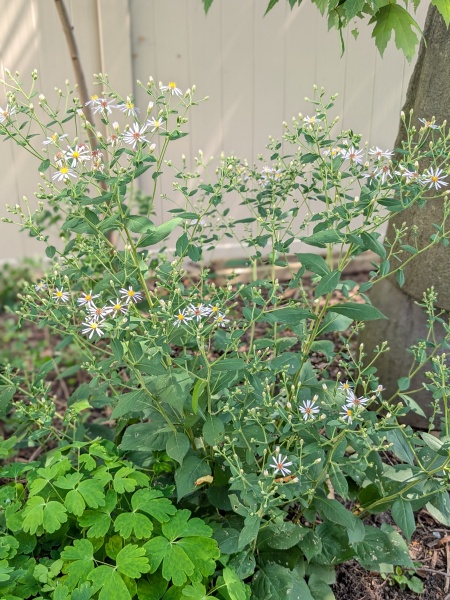
Eurybia macrophylla
Large-leaved Aster
Aster à grandes feuilles
Synonyms
big-leaved aster
large-leaved wood aster
aster à grande feuille
pétouane
Plant Characteristics
Couleur de floraison: Blanc
Bloom Period: Sep - Oct
Hauteur max: 1,0 feet
Max Width: 3,0 feet (spreads by rhizome)
Light Condition:
 Less than 2 or 3 hours of direct sun a day
Soil conditions:
Less than 2 or 3 hours of direct sun a day
Soil conditions:
 Tolère des conditions de sol sec
 Tolerates medium soil condition
Less than 2 or 3 hours of direct sun a day
Tolère des conditions de sol sec
Tolerates medium soil condition
Lifespan:
Vivace
des plantes qui reviennent année après année
Gardener Experience:
 Suitable for beginner gardeners
 Ne se propage pas de manière incontrôlable
 Spreads by rhizome
 Facile à germer
Suitable for beginner gardeners
Ne se propage pas de manière incontrôlable
Spreads by rhizome
Facile à germer
Landscape Uses:
 Suitable for Right of Way gardens
 Suitable for container garden
 Suitable for school gardens
 Suitable for woodland gardens
 Tolerates boulevard garden conditions
Suitable for Right of Way gardens
Suitable for container garden
Suitable for school gardens
Suitable for woodland gardens
Tolerates boulevard garden conditions
Ecological Benefits:
 Butterfly host
 Keystone species
Butterfly host
Keystone species
Tolerates:
 Deer resistant
 Rabbit resistant
 Tolerates limestone conditions
 Tolerates juglone conditions
Deer resistant
Rabbit resistant
Tolerates limestone conditions
Tolerates juglone conditions
Special Features and Considerations:
Seed and plant distribution status
Semences disponible
Disponible à la table Ombre
Disponible à la table Ombre
Nous acceptions les semences de cette plante
Faits intéressants
Large-leaved Aster has large, heart-shaped leaves that form an attractive groundcover. Small clusters of pale lavender to white flowers with yellow centres appear on upright stems in late summer and early fall. It naturally occurs in deciduous forests, woodland openings, and forest edges. It prefers moist, well-drained soil, but once established it can tolerate moderately dry conditions. Its large foliage makes it useful for filling spaces beneath trees where many smaller plants struggle. Give it room to spread; it may be vigorous for a small, tightly planted border. It performs particularly well beneath deciduous trees. It can be divided in spring if you want to move or control the spread.
Plant Location
Native to Ottawa region: Oui
Distribution according to VASCAN
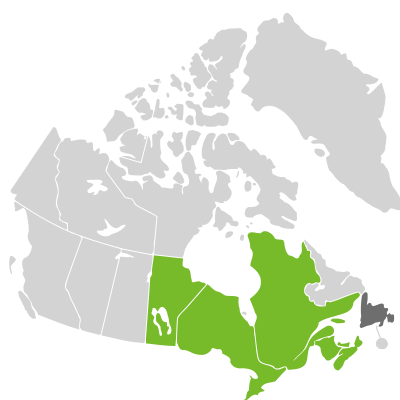
Ephemeral
Native
Introduced
Excluded
Extirpated
Doubtful
Absent
 Canadensis

Thrives in Ecozones
- Plaines à forêts mixtes
Ecological Benefits
Butterflies Supported by Eurybia macrophylla
-
Eupithecia miserulata
American Common Pug
Specialized Bees Supported by Eurybia macrophylla
- Andrena asteris
- Andrena canadensis
- Andrena placata
- Andrena simplex
- Melissodes druriellus
- Protandrena andrenoides
Complementary Plants
- Campanulastrum americanum
American Bellflower
Campanule d'Amérique - Carex crinita
Fringed Sedge
Carex crépu - Nabalus albus
White Rattlesnake-root
Prenanthe blanche - Scrophularia marilandica
Eastern/carpenter's Figwort
Scrofulaire du Maryland - Symphyotrichum urophyllum
Arrow-leaved Aster
Aster urophylle
Substitute For Non-Native Plants
- Ajuga reptans (Bugleweed)
- Aegopodium podagraria (Goutweed)
- Convallaria majalis (Lily of the Valley)
- Pachysandra terminalis (Japanese Pachysandra)
- Funkia (Hosta)
- Symphiotrichum (Non-Native Aster)
Sowing Information
Download Seed Envelope Labels (PDF)
- Sowing depth: Surface sow
- Sow by February
- Stratification duration: 60 days
Harvesting and Seed Sharing
- Harvest start month: September
- Harvesting indicator:
- Seeds have become fluffy and can be easily removed by shaking on gently pulling off from stem
- Harvesting:
- Secouer le porte-graines dans un sac de papier
- Seed viability test:
- Pas de test requis avant le don
- Packaging measure: 1 rounded 1/4 teaspoon
- Seed storage:
- Sécher à l'air dans un sac en papier ou contenant ouvert, pour quelques jours jusqu'à sec
- Secouer de temps à autre pour prévenir la moisissure
- Cultivar: Yes, do not donate unless you know source, and there are no known cultivars in your garden or at proximity
- Harvesting notes: You do note have to remove the fluff.
- No harvesting video available at this time.
Toxicity Notes
Not known to be toxic to mammals if ingested.