 Inconnu - Inadequate information on toxicity found.
Plant Names

Capnoides sempervirens
Pink Corydalis
Corydale toujours verte
Synonyms
harlequin flower
pale corydalis
pink and yellow corydalis
rock harlequin
corydale toujours-verte
corydalis pâle
corydalis toujours verte
Plant Characteristics
Couleur de floraison: Rose
Bloom Period: Jun - Aug
Hauteur max: 3,0 feet
Max Width: 2,0 feet
Light Condition:
 Plus de 6 heures d'ensoleillement par jour
 More than 2 or 3 hours but less than 6 hours of direct sun a day
Soil conditions:
More than 2 or 3 hours but less than 6 hours of direct sun a day
Soil conditions:
 Tolère des conditions de sol sec
Plus de 6 heures d'ensoleillement par jour
More than 2 or 3 hours but less than 6 hours of direct sun a day
Tolère des conditions de sol sec
Lifespan:
Annuel
des plantes qui ont une durée de vie d'un an
Gardener Experience:
 Ne se propage pas de manière incontrôlable
 Facile à germer
 Self-seeding
Ne se propage pas de manière incontrôlable
Facile à germer
Self-seeding
Landscape Uses:
 Suitable for rock gardens
 Suitable for container garden
 Suitable for school gardens
Suitable for rock gardens
Suitable for container garden
Suitable for school gardens
Ecological Benefits:
No ecological benefits information available.
Tolerates:
Special Features and Considerations:
 This plant is a GRASP candidate
This plant is a GRASP candidate
Seed and plant distribution status
Semences disponible
Disponible à la table Mi-soleil, sec
Disponible à la table Mi-soleil, sec
Nous acceptions les semences de cette plante
Faits intéressants
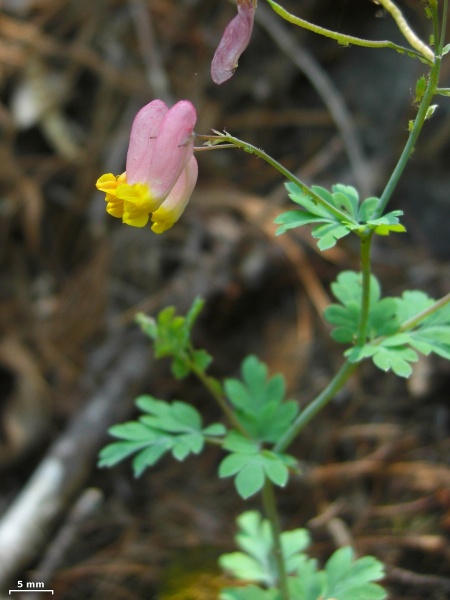
Pink Corydalis grows in rocky landscapes and areas disturbed by fire. It has distinctive pink tubular flowers with yellow tips and blue-green fernlike foliage. The name derives from the Latin ‘semper’ meaning always and ‘virens’ meaning green. It prefers cooler temperatures and dry but well-drained soils. For home gardens, it is well suited for dry areas in the garden.
Plant Location
Native to Ottawa region: Oui
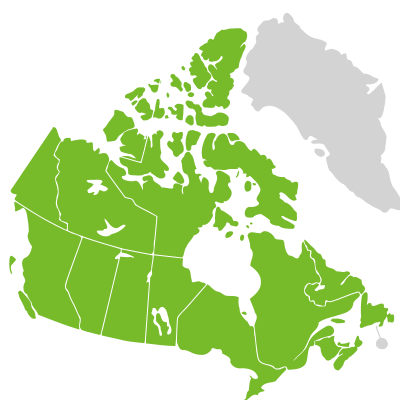
Distribution according to VASCAN
Ephemeral
Native
Introduced
Excluded
Extirpated
Doubtful
Absent
 Canadensis

Thrives in Ecozones
- Taïga des plaines
- Taïga du Bouclier
- Plaines boréales
- Plaines à forêts mixtes
Ecological Benefits
Butterflies Supported by Capnoides sempervirens
No butterfly data available for this plant.
Specialized Bees Supported by Capnoides sempervirens
No bee data available for this plant.
Complementary Plants
- Allium stellatum
Autumn Onion
Ail étoilé - Drymocallis arguta
Tall Wood Beauty
Potentille âcre - Eragrostis spectabilis
Purple Lovegrass
Éragrostide brillante - Liatris cylindracea
Cylindrical Blazing Star
Liatris cylindrique - Monarda punctata
Spotted Beebalm
Monarde ponctuée
Substitute For Non-Native Plants
- Lamprocapnos spectabilis (Bleeding hearts)
- Phlox subulata (Moss Phlox)
Sowing Information
Download Seed Envelope Labels (PDF)
- Sowing depth: Couvrir très légèrement
- Sow by March
- Stratification duration: 30 days
- Self-seeding
Harvesting and Seed Sharing
- Harvest start month: May
- Harvesting indicator:
- Pods are slightly open and seeds inside are dark
- Harvesting:
- Ouvrir la gousse, enlever les graines
- Seed viability test:
- Pas de test requis avant le don
- Packaging measure: 1 rounded 1/32 teaspoon
- Seed storage:
- Sécher à l'air dans un sac en papier ou contenant ouvert, pour quelques jours jusqu'à sec
- Secouer de temps à autre pour prévenir la moisissure
- Cultivar: No, you can donate without knowing the source as there are only straight species
- Remove non-seed material
- No harvesting video available at this time.
Toxicity Notes
Inadequate information on toxicity found.
GRASP Candidate
Overlooked or difficult to grow plants (eg ghost plants, shrubs, trees, complicated germination etc); sapling sitters, seed sitters, skilled germination, growers with right conditions- aiming for local stock; these plants may not be extinct, but overlooked OR support habitat OR support a vulnerable animal/insect.