 Connu comme étant toxique - Toxic to mammals if ingested. A poisonous plant, sneezeweed can trigger adverse responses in individuals who consume significant quantities. Symptoms range from mild to severe, potentially becoming life-threatening. The blossoms, seeds, and foliage all contain toxins. Ingesting the plant may lead to stomach discomfort, excessive salivation, elevated body temperature, throwing up, seizures, and labored breathing.
Plant Names

Helenium autumnale
Sneezeweed
Hélénie automnale
Synonyms
fall sneezeweed
mountain sneezeweed
swamp sunflower
hélénie d'automne
Plant Characteristics
Couleur de floraison: Jaune
Bloom Period: Aug - Oct
Hauteur max: 4,0 feet
Max Width: 2,0 feet (spreads by rhizome)
Light Condition:
 Plus de 6 heures d'ensoleillement par jour
 More than 2 or 3 hours but less than 6 hours of direct sun a day
Soil conditions:
More than 2 or 3 hours but less than 6 hours of direct sun a day
Soil conditions:
 Tolerates medium soil condition
Plus de 6 heures d'ensoleillement par jour
More than 2 or 3 hours but less than 6 hours of direct sun a day
Tolerates medium soil condition
Lifespan:
Vivace
des plantes qui reviennent année après année
Gardener Experience:
 Suitable for beginner gardeners
 Spreads by rhizome
 Facile à germer
 Self-seeding
Suitable for beginner gardeners
Spreads by rhizome
Facile à germer
Self-seeding
Landscape Uses:
 Souhaitable dans les jardins de zone humide
 Suitable for rain gardens
 Suitable for container garden
 Suitable for school gardens
Souhaitable dans les jardins de zone humide
Suitable for rain gardens
Suitable for container garden
Suitable for school gardens
Ecological Benefits:
 Butterfly host
Butterfly host
Tolerates:
 Tolerates salt conditions
 Deer resistant
 Rabbit resistant
 Tolerates limestone conditions
 Tolerates juglone conditions
Tolerates salt conditions
Deer resistant
Rabbit resistant
Tolerates limestone conditions
Tolerates juglone conditions
Special Features and Considerations:
 This plant causes skin rashes
This plant causes skin rashes
Seed and plant distribution status
Semences disponible
Disponible à la table Mi-soleil, humide
Disponible à la table Mi-soleil, humide
Nous acceptions les semences de cette plante
Faits intéressants
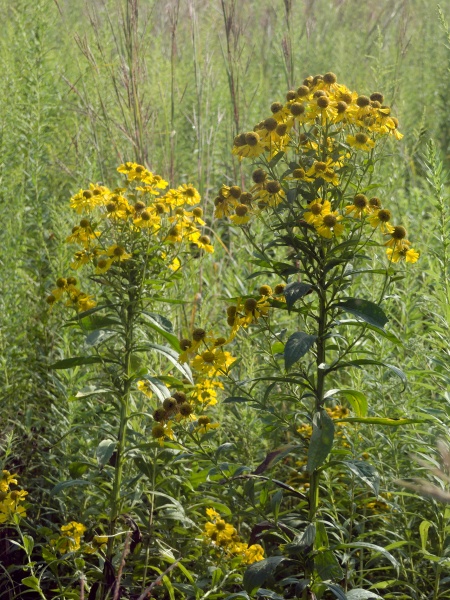
Common Sneezeweed is an adaptable plant that often grows best in open, moist areas such as near ponds and streams. It produces an abundance of vivid, daisy-like blooms in the late summer and early fall. Despite its name, it does not cause seasonal allergies, as its pollen is spread by insects and not in the wind. The name “sneezeweed” comes from an old folkloric tradition where the flowers were dried and sniffed to induce sneezing and release evil spirits; it is, however, poisonous to humans.
Plant Location
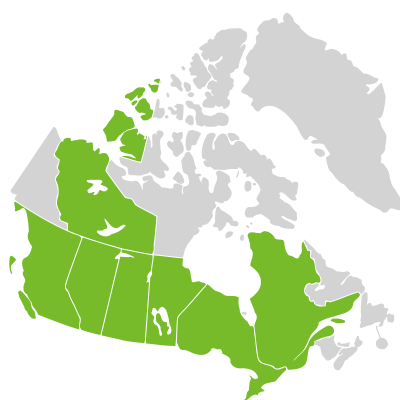
Native to Ottawa region: Oui
Distribution according to VASCAN
Ephemeral
Native
Introduced
Excluded
Extirpated
Doubtful
Absent
 Canadensis

Thrives in Ecozones
- Maritime de l'Atlantique
- Plaines boréales
- Bouclier boréal
- Maritime du Pacifique
- Plaines à forêts mixtes
Ecological Benefits
Butterflies Supported by Helenium autumnale
-
Chlorochlamys chloroleucaria
Blackberry looper - Arpenteuse des ronces -
Nathalis iole
Dainty Sulphur
Specialized Bees Supported by Helenium autumnale
No bee data available for this plant.
Complementary Plants
- Glyceria canadensis
Canada Mannagrass
Glycérie du Canada - Hibiscus moscheutos
Swamp Rose-mallow
Ketmie des marais - Impatiens capensis
Spotted Jewelweed
Impatiente du Cap - Lobelia siphilitica
Great Blue Lobelia
Lobélie bleue - Physostegia virginiana
Obedient Plant
Physostégie de Virginie
Substitute For Non-Native Plants
- Leucanthemum (Shasta Daisy)
- Gerbera (Gerbera Daisy)
- NA (Non-native False Sunflower)
Sowing Information
Download Seed Envelope Labels (PDF)
- Sowing depth: Surface sow
- Sow anytime
- Stratification duration: 0 days
- Self-seeding
- Notes: Can be sown anytime.
Harvesting and Seed Sharing
- Harvest start month: September
- Harvesting indicator:
- Seeds easily fall off when you gently pull them off
- Harvesting:
- Secouer le porte-graines dans un sac de papier
- Seed viability test:
- Pas de test requis avant le don
- Packaging measure: 1 rounded 1/8 teaspoon
- Seed storage:
- Sécher à l'air dans un sac en papier ou contenant ouvert, pour quelques jours jusqu'à sec
- Secouer de temps à autre pour prévenir la moisissure
- Cultivar: Yes, do not donate unless you know source, and there are no known cultivars in your garden or at proximity
- Remove non-seed material
- Harvesting video: Watch here
Toxicity Notes
Toxic to mammals if ingested. A poisonous plant, sneezeweed can trigger adverse responses in individuals who consume significant quantities. Symptoms range from mild to severe, potentially becoming life-threatening. The blossoms, seeds, and foliage all contain toxins. Ingesting the plant may lead to stomach discomfort, excessive salivation, elevated body temperature, throwing up, seizures, and labored breathing.