 Connu comme étant toxique - The whole plant is toxic, precautions should be taken to avoid accidental ingestion, especially by children and pets who may be attracted to its grass-like appearance
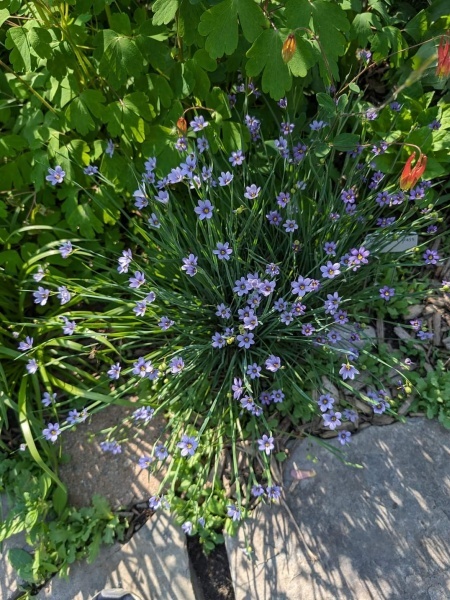
Plant Names

Sisyrinchium montanum
Strict Blue-eyed-grass
Bermudienne montagnarde
Synonyms
little blue-eyed-grass
mountain blue-eyed-grass
bermudienne
bermudienne commune
bermudienne des montagnes
herbe aux yeux bleus
sisyrinchium des montagnes
Plant Characteristics
Couleur de floraison: Violet
Bloom Period: May - Jun
Hauteur max: 0,5 feet
Max Width: 0,8 feet (spreads by rhizome)
Light Condition:
 Plus de 6 heures d'ensoleillement par jour
Soil conditions:
Plus de 6 heures d'ensoleillement par jour
Soil conditions:
 Tolerates medium soil condition
Plus de 6 heures d'ensoleillement par jour
Tolerates medium soil condition
Lifespan:
Vivace
des plantes qui reviennent année après année
Gardener Experience:
 Suitable for beginner gardeners
 Ne se propage pas de manière incontrôlable
 Spreads by rhizome
 Self-seeding
Suitable for beginner gardeners
Ne se propage pas de manière incontrôlable
Spreads by rhizome
Self-seeding
Landscape Uses:
 Suitable for rock gardens
 Suitable for rain gardens
 Suitable for container garden
Suitable for rock gardens
Suitable for rain gardens
Suitable for container garden
Ecological Benefits:
No ecological benefits information available.
Tolerates:
 Tolerates acidic soil conditions
 Tolerates transplantation
Tolerates acidic soil conditions
Tolerates transplantation
Special Features and Considerations:
Seed and plant distribution status
No seeds available for this plant.
Nous acceptions les semences de cette plante
Faits intéressants
Strict Blue-Eyed Grass, is actually a member of the iris family rather than the grass family. While most iris family members prefer wet lands, Blue-Eyed Grass prefers prairie grasslands. Due to their small size, they are best noticed edging along a path. Since it often grows in specialized habitats, it prefers to grow amongst small plants that are not aggressive or competitive. Its blooms open in the morning and close in the evening, so be sure to observe them early in the day.
Strict Blue-Eyed Gras is a well-behaved, clumping perennial that does not aggressively spread. It is best planted in groups for visual impact. It can go dormant or look less attractive during hot, dry periods. You can divide clumps every few years if they become crowded. It works well in small gardens where larger native plants may overwhelm the space.
Strict Blue-Eyed Gras is a well-behaved, clumping perennial that does not aggressively spread. It is best planted in groups for visual impact. It can go dormant or look less attractive during hot, dry periods. You can divide clumps every few years if they become crowded. It works well in small gardens where larger native plants may overwhelm the space.
Plant Location
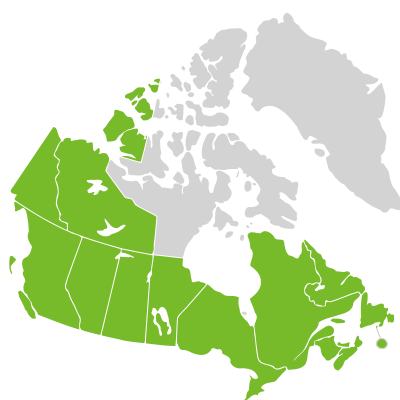
Native to Ottawa region: Oui
Distribution according to VASCAN
Ephemeral
Native
Introduced
Excluded
Extirpated
Doubtful
Absent
 Canadensis

Thrives in Ecozones
- Taïga des plaines
- Taïga du Bouclier
- Plaines boréales
- Cordillière montagnarde
- Bouclier boréal
- Cordillière boréale
Ecological Benefits
Butterflies Supported by Sisyrinchium montanum
No butterfly data available for this plant.
Specialized Bees Supported by Sisyrinchium montanum
No bee data available for this plant.
Complementary Plants
- Antennaria howellii
Howell's Pussytoes
Antennaire de Howell - Antennaria parlinii
Parlin's Pussytoes
Antennaire de Parlin - Fragaria virginiana
Virginia Strawberry
Fraisier des champs - Plantago rugelii
Rugel's Plantain
Plantain de Rugel - Sisyrinchium angustifolium
Narrow-leaved Blue-eyed Grass
Bermudienne à feuilles étroites
Substitute For Non-Native Plants
- Lamium (Dead nettle)
- Perovskia Atriplicifolia (Russian Sage)
- Lupinus (Non-Native Lupins)
- Ajuga reptans (Bugleweed)
- Buddleia (Butterfly Bush)
- Delphinium (Delphinium)
- Hydrangea (Hydrangea)
- Aegopodium podagraria (Goutweed)
- Alliums (Non-Native Alliums)
- Rhamnus cathartica (Common Buckthorn)
- Rhamnus frangula (Glossy Buckthorn)
- Miscanthus (Silvergrass)
- Cortaderia selloana (Pampas Grass)
- Phalaris arundinacea (Reed Canary Grass)
- Convallaria majalis (Lily of the Valley)
- Polygonatum odoratum).1 (Solomon's Seal)
- Lysimachia nummularia (Creeping Jenny)
- Iridaceae (Crocus)
- Scilla siberica (Siberian Squill)
- Salvia (Non-Native Sage)
- Myosotis sylvatica (Forget-me-not)
- Phlox subulata (Moss Phlox)
Sowing Information
Download Seed Envelope Labels (PDF)
- Sowing depth: Couvrir très légèrement
- Sow anytime
- Stratification duration: 45 days
- Self-seeding
Harvesting and Seed Sharing
- Harvest start month: July
- Harvesting indicator:
- Pods are brown and crisp and starting to open
- Seeds are dark and tiny stem attaching to the main stem is brown
- Seeds easily fall off pod when shaken
- Little stem connecting the pod to the main stem is brown (not green)
- Harvesting:
- Cut stem (including pods), let air dry in paper bag, then shake seeds off after a few days
- Seed viability test:
- Pas de test requis avant le don
- Packaging measure: 1 rounded 1/32 teaspoon
- Seed storage:
- Sécher à l'air dans un sac en papier ou contenant ouvert, pour quelques jours jusqu'à sec
- Secouer de temps à autre pour prévenir la moisissure
- Cultivar: No, you can donate without knowing the source as there are only straight species
- Remove non-seed material
- Harvesting video: Watch here
Toxicity Notes
The whole plant is toxic, precautions should be taken to avoid accidental ingestion, especially by children and pets who may be attracted to its grass-like appearance