 Inconnu - Inadequate information on toxicity found.
Plant Names

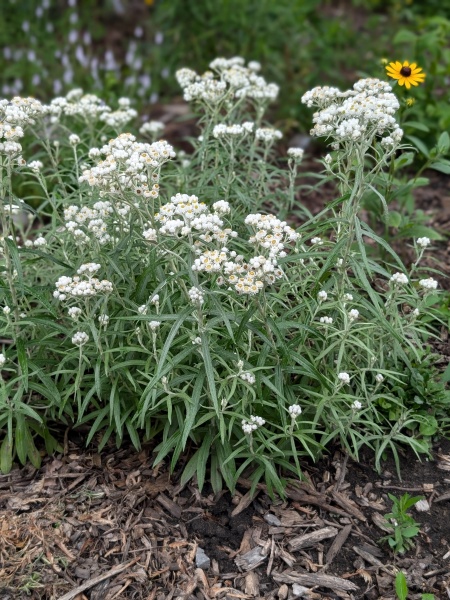
Anaphalis margaritacea
Pearly Everlasting
Immortelle blanche
Synonyms
anaphale perlée
immortelle
Plant Characteristics
Couleur de floraison: Blanc
Bloom Period: Jul - Aug
Hauteur max: 2,0 feet
Max Width: 3,0 feet (spreads by rhizome)
Light Condition:
 Plus de 6 heures d'ensoleillement par jour
 More than 2 or 3 hours but less than 6 hours of direct sun a day
Soil conditions:
More than 2 or 3 hours but less than 6 hours of direct sun a day
Soil conditions:
 Tolerates medium soil condition
Plus de 6 heures d'ensoleillement par jour
More than 2 or 3 hours but less than 6 hours of direct sun a day
Tolerates medium soil condition
Lifespan:
Vivace
des plantes qui reviennent année après année
Plant is
dioecious
Need a male and female plant to produce seeds
Gardener Experience:
 Suitable for beginner gardeners
 Spreads by rhizome
 Facile à germer
 Self-seeding
Suitable for beginner gardeners
Spreads by rhizome
Facile à germer
Self-seeding
Landscape Uses:
 Suitable for rock gardens
 Suitable for Right of Way gardens
 Suitable for rain gardens
 Suitable for shoreline rehabilitation
 Suitable for container garden
 Suitable for school gardens
 Tolerates boulevard garden conditions
Suitable for rock gardens
Suitable for Right of Way gardens
Suitable for rain gardens
Suitable for shoreline rehabilitation
Suitable for container garden
Suitable for school gardens
Tolerates boulevard garden conditions
Ecological Benefits:
 Butterfly host
Butterfly host
Tolerates:
 Tolerates salt conditions
 Deer resistant
 Rabbit resistant
 Tolerates limestone conditions
 Tolerates sandy conditions
 Tolerates transplantation
Tolerates salt conditions
Deer resistant
Rabbit resistant
Tolerates limestone conditions
Tolerates sandy conditions
Tolerates transplantation
Special Features and Considerations:
 This plant is septic tank safe
This plant is septic tank safe
Seed and plant distribution status
Semences disponible
Disponible à la table Plein soleil, moyen
Disponible à la table Plein soleil, moyen
Nous acceptions les semences de cette plante
Faits intéressants
Pearly Everlasting's leaves and stem have a silvery appearance which adds visual appeal to the garden. It is not picky about the soil it grows in. If you want to donate seeds you will need to have separate male and female plants. The cute little white flowers are also popular in dried flower arrangements as they retain their shape well. Caterpillars create a silken web around the plant while feeding. This will not damage the plant and it will make a full recovery later in the summer.
Plant Location
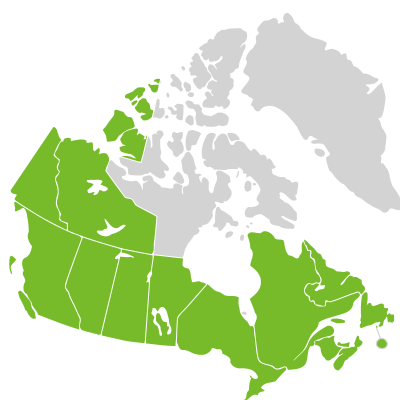
Native to Ottawa region: Oui
Distribution according to VASCAN
Ephemeral
Native
Introduced
Excluded
Extirpated
Doubtful
Absent
 Canadensis

Thrives in Ecozones
- Taïga des plaines
- Maritime de l'Atlantique
- Taïga du Bouclier
- Plaines boréales
- Cordillière montagnarde
- Prairies
- Bouclier boréal
- Maritime du Pacifique
- Plaines à forêts mixtes
Ecological Benefits
Butterflies Supported by Anaphalis margaritacea
-
Cingilia catenaria
Chain-dotted geometer - Arpenteuse caténaire -
Neocaloreas leucobasis
Neocaloreas leucobasis -
Vanessa virginiensis
American Lady - Vanesse de Virginie
Specialized Bees Supported by Anaphalis margaritacea
No bee data available for this plant.
Complementary Plants
- Asclepias tuberosa
Butterfly Milkweed
Asclépiade tubéreuse - Liatris spicata
Dense Blazing Star
Liatris à épi - Monarda fistulosa
Wild Bergamot
Monarde fistuleuse - Rudbeckia hirta
Black-eyed Susan
Rudbeckie hérissée - Schizachyrium scoparium
Little Bluestem Grass
Barbon à balais
Substitute For Non-Native Plants
- Hydrangea (Hydrangea)
- Aegopodium podagraria (Goutweed)
Sowing Information
Download Seed Envelope Labels (PDF)
- Sowing depth: Surface sow
- Sow by March
- Stratification duration: 30 days
- Self-seeding
Harvesting and Seed Sharing
- Harvest start month: October
- Harvesting indicator:
- Seeds have become fluffy and can be easily removed by shaking on gently pulling off from stem
- Harvesting:
- Utiliser la main pour détacher de la tige principale
- Seed viability test:
- Pas de test requis avant le don
- Packaging measure: 1 rounded 1/8 teaspoon
- Seed storage:
- Sécher à l'air dans un sac en papier ou contenant ouvert, pour quelques jours jusqu'à sec
- Secouer de temps à autre pour prévenir la moisissure
- Cultivar: Yes, do not donate unless you know source, and there are no known cultivars in your garden or at proximity
- Harvesting video: Watch here
Toxicity Notes
Inadequate information on toxicity found.