 Known to be toxic - Foliage can be toxic to livestock, particularly horses, when wilted or dried. Leaves can cause serious illness and potentially fatal poisoning in horses.
Plant Names

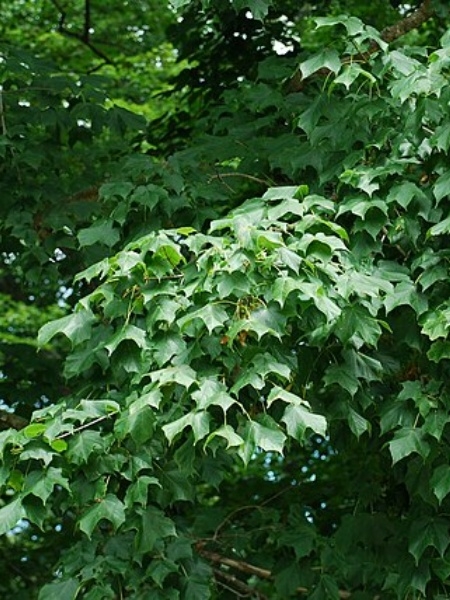
Acer nigrum
Black Maple
Érable noir
Plant Characteristics
Bloom Colour: Green
Bloom Period: Apr - Apr
Max Height: 95.0 feet
Max Width: 60.0 feet
Light Condition:
 More than 6 hours of direct sun a day
 More than 2 or 3 hours but less than 6 hours of direct sun a day
Soil conditions:
More than 2 or 3 hours but less than 6 hours of direct sun a day
Soil conditions:
 Tolerates medium soil condition
More than 6 hours of direct sun a day
More than 2 or 3 hours but less than 6 hours of direct sun a day
Tolerates medium soil condition
Lifespan:
Perennial
plants that will come back year after year
Gardener Experience:
 Self-seeding
Self-seeding
Landscape Uses:
No landscape information available.
Ecological Benefits:
 Butterfly host
 Keystone species
Butterfly host
Keystone species
Tolerates:
 Tolerates drought conditions
 Tolerates limestone conditions
 Tolerates acidic soil conditions
 Tolerates juglone conditions
Tolerates drought conditions
Tolerates limestone conditions
Tolerates acidic soil conditions
Tolerates juglone conditions
Special Features and Considerations:
 This plant is a GRASP candidate
This plant is a GRASP candidate
Seed and plant distribution status
No seeds available for this plant.
We currently accept seeds for this plant
Fun Facts
Black Maple is closely related to sugar maple, growing in rich forests, floodplains, and moist woodland areas. It has a dense, rounded crown, dark grey bark, and large leaves. It is an excellent choice for large properties and restoration projects. It is not suitable for small urban gardens. An excellent choice as a long-term shade tree where there is room for a mature canopy. It generally slow to moderately growing and can live for many decades. Young trees benefit from protection from deer and other browsing animals. Avoid planting directly beneath overhead utility lines. The extensive root system and mature canopy make it unsuitable for very small yards or locations close to foundations, septic systems or narrow planting beds.
Plant Location
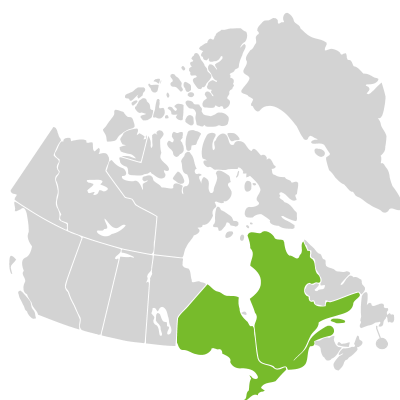
Native to Ottawa region: Yes
Distribution according to VASCAN
Ephemeral
Native
Introduced
Excluded
Extirpated
Doubtful
Absent
 Canadensis

Ecological Benefits
Butterflies Supported by Acer nigrum
-
Eacles imperialis
Imperial - Papillon Impérial
Specialized Bees Supported by Acer nigrum
No bee data available for this plant.
Complementary Plants
- Ageratina altissima
White Snakeroot
Eupatoire rugueuse - Anemone virginiana
Tall Anemone
Anémone de Virginie - Asarum canadense
Canada Wild Ginger
Asaret du Canada - Asclepias exaltata
Poke Milkweed
Asclépiade très grande - Asclepias incarnata
Swamp Milkweed
Asclépiade incarnate - Coreopsis lanceolata
Lance-leaved Coreopsis
Coréopsis lancéolé - Diervilla lonicera
Northern Bush-honeysuckle
Dièreville chèvrefeuille - Elymus hystrix
Bottlebrush Grass
Élyme étalé - Eurybia divaricata
White Wood Aster
Aster à rameaux étalés - Eurybia macrophylla
Large-leaved Aster
Aster à grandes feuilles - Geranium maculatum
Spotted Geranium
Géranium maculé - Helianthus divaricatus
Woodland Sunflower
Hélianthe à feuilles étalées - Hydrophyllum virginianum
Virginia Waterleaf
Hydrophylle de Virginie - Maianthemum racemosum
Large False-solomon's Seal
Smilacine à grappes - Phlox divaricata
Wild Blue Phlox
Phlox divariqué - Rubus odoratus
Purple-flowering Raspberry
Ronce odorante - Rudbeckia hirta
Black-eyed Susan
Rudbeckie hérissée - Sambucus racemosa
Red Elderberry
Sureau à grappes - Sanguinaria canadensis
Bloodroot
Sanguinaire du Canada - Solidago bicolor
White Goldenrod
Verge d'or bicolore - Solidago caesia
Blue-stemmed Goldenrod
Verge d'or bleuâtre - Solidago flexicaulis
Zigzag Goldenrod
Verge d'or à tige zigzagante - Symphyotrichum cordifolium
Heart-leaved Aster
Aster à feuilles cordées - Viburnum acerifolium
Maple-leaved Viburnum
Viorne à feuilles d'érable - Viola sororia
Woolly Blue Violet
Violette parente
Substitute For Non-Native Plants
- Acer japonicum (Japanese Maple)
- Acer platanoides (Norway Maple)
Sowing Information
Download Seed Envelope Labels (PDF)
- Sowing depth: 3/8 inch
- Sow by January
- Stratification conditions: Soak for 24h
- Stratification duration: 90 days
- Self-seeding
Harvesting and Seed Sharing
- Harvest start month: June
- Harvesting indicator:
- Pods are released from plant
- Harvesting:
- Nut has been released from tree
- Seed viability test:
- None
- Packaging measure: Six (6) seeds (eyeball)
- Seed storage:
- Air Dry in paper bag or open container, for a few days until crisp
- Shake seeds to move them once in a while to prevent molding
- Cultivar: Yes, do not donate unless you know source, and there are no known cultivars in your garden or at proximity
- Remove non-seed material
- No harvesting video available at this time.
Toxicity Notes
Foliage can be toxic to livestock, particularly horses, when wilted or dried. Leaves can cause serious illness and potentially fatal poisoning in horses.
GRASP Candidate
Rare/endangered native plants within 50km radius of Ottawa approximately. Burton is anchor study, plus iNaturalist observations to corroborate if any recent spotting.